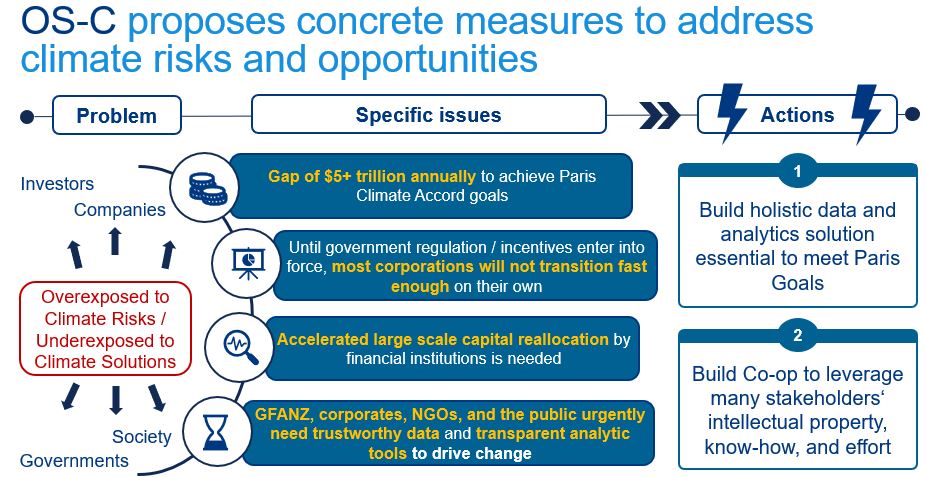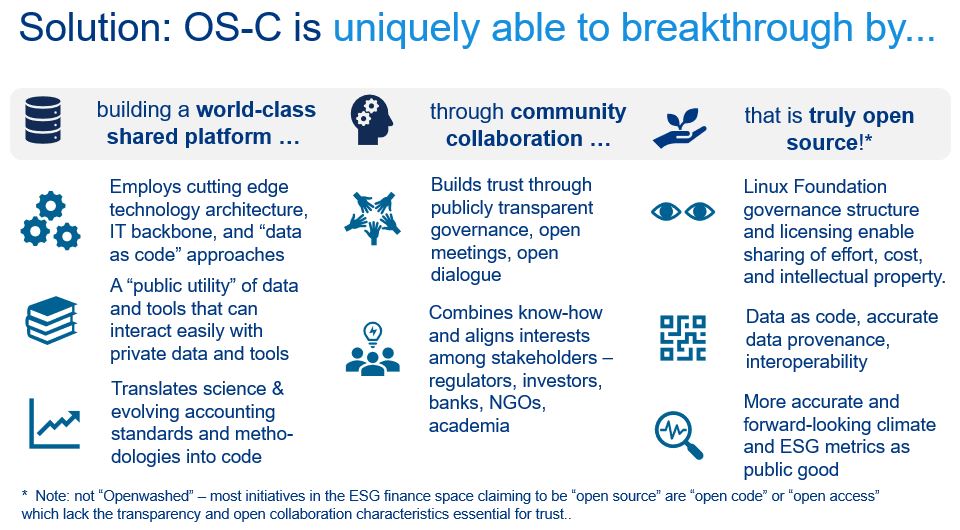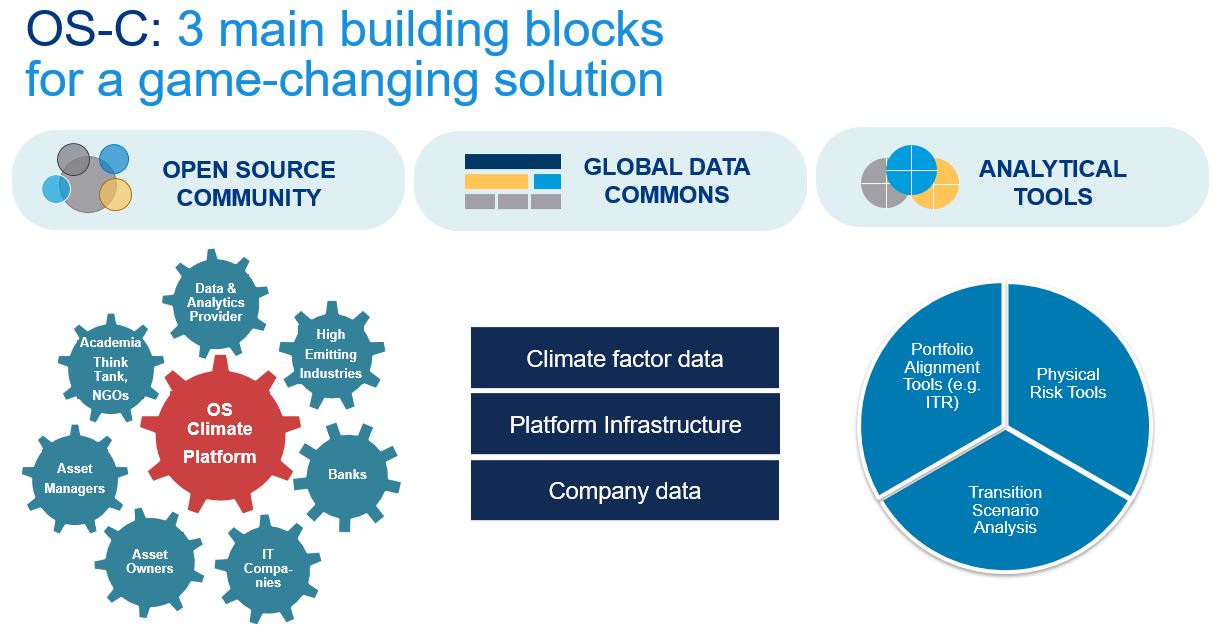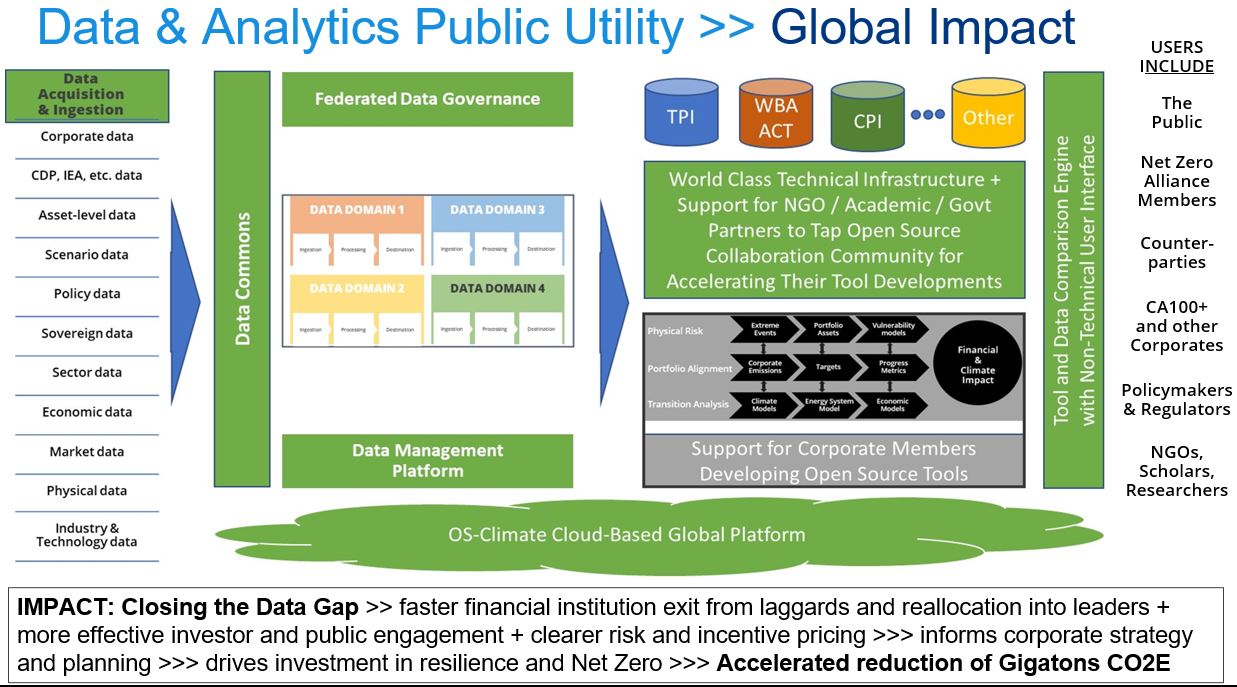
Apply the Community-Based Open Source approach that has enabled breakthroughs in Life Sciences & Tech to solve data & analytics challenges required for investment to achieve Paris Climate Accord goals.

Governance, licensing, and collaboration structures enabling stakeholders to share cost, intellectual property, and effort.
Joint projects for new data, modeling, standards, and supporting technology.

Curated library of public and private sources, for both transition and physical risk/ opportunity.
More accurate corporate historical and forwardlooking climate & ESG metrics as a public good.

Top-down and bottom-up modeling to integrate climate-related risk and opportunity into decisions by investors, financial institutions, regulators, etc.
Multiple climate scenarios and transition pathways.

Stress testing
Stress testing
Asset allocation
Portfolio construction
Research (investment, banking, etc.)
Manager selection
Analysis of securities & loans
Design and execution of benchmarks, strategies & products
Disclosure & reporting
Engagement with companies & financial institutions


Top Down Model from Ortec Finance/Cambridge Econometrics.
Bottom Up Model by Entelligent.
Physical Risk Extreme Event Data by Jupiter Intelligence (depicted in next schematic).


For Paris Orderly, we assume that markets will gradually price in from 2020 – 2024
For Paris Disorderly, we assume that pricing in will take place instantaneously in one year in 2024.
For Failed Transition, we assume that pricing in of future physical impacts will take place in 2025 – 2029. Global shock: -15% (preliminary, indicative).
For Singapore (preliminary, indicative): Paris aligned -2%, Failed Transition -12%


Disaggregation of total climate risk impact to individual climate factors: example for MSCI World Equity benchmark
(available for each modelled macro-economic and financial variable)


For example, users can vary policy and technology variables to see how they affect deployment of renewable energy in India.

How robust is your portfolio for different climate paths?
Example: model-based risk-return projections

For example, users can vary policy and technology variables to see how these affect the relative exposure of asset classes & regions to the different global warming pathways
Note: these are results based on a fictive demo set-up, results will vary for each specific investor.
Security Level Return Projections
(For multiple energy transition and global warming pathways)


— Wireframe of planned interface


Stress testing